
Introduction: Why Businesses Struggle to Choose Between SEO and Google Ads
If you’ve ever spoken with a business owner about marketing, you’ve probably heard the question: “Should I invest in SEO or Google Ads?”
It’s a fair question. After all, both can bring traffic, leads, and sales. But they work very differently, and that’s where the confusion starts.
Most businesses don’t have unlimited marketing budgets. Every rupee matters. Whether you’re running a local service company, an eCommerce store, or a growing startup, you want your marketing investment to produce real results. Fast, if possible.
Google Ads offers immediate visibility. Your business can appear at the top of search results within hours. SEO, on the other hand, takes time. Sometimes several months. Yet the traffic it generates can continue long after the initial work is done.
Think about a local home renovation company. With Google Ads, they can show up for searches like “home renovation contractor near me” almost instantly. Leads may start arriving the same day. But the moment the ad budget stops, the visibility disappears too.
SEO works differently. It requires patience. You create useful content, optimize your website, improve technical performance, and build authority. The results aren’t immediate, but once rankings improve, traffic often keeps coming without paying for every click.
This is why many business owners feel stuck between the two options.
The reality? There’s no universal winner.
Your ideal strategy depends on your goals, timeline, competition, and budget. Some businesses need leads now. Others want to build long-term authority and reduce advertising costs over time.
Before deciding where to invest, it’s important to understand how both channels work and what they can realistically deliver.
What Is SEO and How Does It Work?
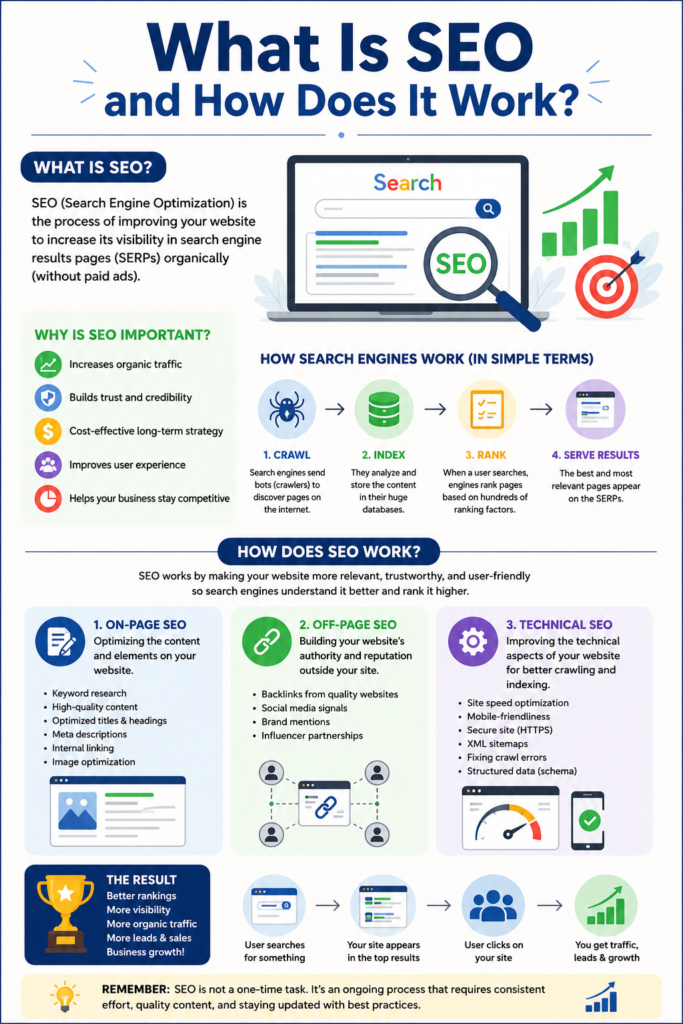
SEO, or Search Engine Optimization, is the process of helping your website appear higher in Google’s organic search results.
When someone searches for a service or product online, Google sorts through millions of pages to find the most relevant answers. SEO helps your website become one of those answers.
Simple in theory. Not always simple in practice.
A strong SEO strategy starts with understanding what your customers are actually searching for. These search terms become the foundation of your content and website optimization efforts.
From there, several things happen.
You create useful content. You improve website speed. You optimize page structure. You make navigation easier. You earn backlinks from trusted websites. Over time, these signals tell Google that your site is valuable and trustworthy.
Let’s say you own a landscaping business.
Instead of only listing your services, you begin publishing helpful articles about lawn maintenance, seasonal gardening tips, irrigation systems, and landscape design ideas. Gradually, Google starts recognizing your expertise.
As rankings improve, more people discover your website through organic search.
The biggest advantage? You’re not paying for every visitor.
Of course, SEO isn’t a quick fix. Many businesses expect first-page rankings within a few weeks and become frustrated when it doesn’t happen. That’s rarely how SEO works.
The businesses that see the best results usually view SEO as a long-term investment rather than a short-term marketing tactic.
Done properly, SEO becomes a digital asset that continues generating traffic, leads, and visibility long into the future.
Why Every Business Needs a Digital Marketing Strategy
Many business owners jump straight into tactics.
They run ads. Post on social media. Publish a few blogs.
Then they wonder why results are inconsistent.
The problem usually isn’t the marketing channel. It’s the lack of strategy.
Today’s customers spend a significant amount of time online before making a purchase decision. They research products, compare providers, read reviews, and visit multiple websites before contacting a business.
If your company isn’t visible during that journey, competitors will gladly take your place.
That’s why every business needs a clear digital marketing strategy.
A good strategy helps answer important questions:
Who are your ideal customers?
What problems are they trying to solve?
Which channels are most likely to reach them?
How will you measure success?
For example, a local law firm may use SEO to attract long-term organic traffic while running Google Ads for high-intent searches that generate immediate consultations.
A home services company might focus on local SEO while supplementing visibility with paid search campaigns during peak seasons.
Different businesses need different approaches.
The goal isn’t simply to increase website traffic. Traffic alone doesn’t pay the bills.
The real goal is attracting qualified prospects who are likely to become customers.
When marketing activities are guided by a clear strategy, every dollar works harder.
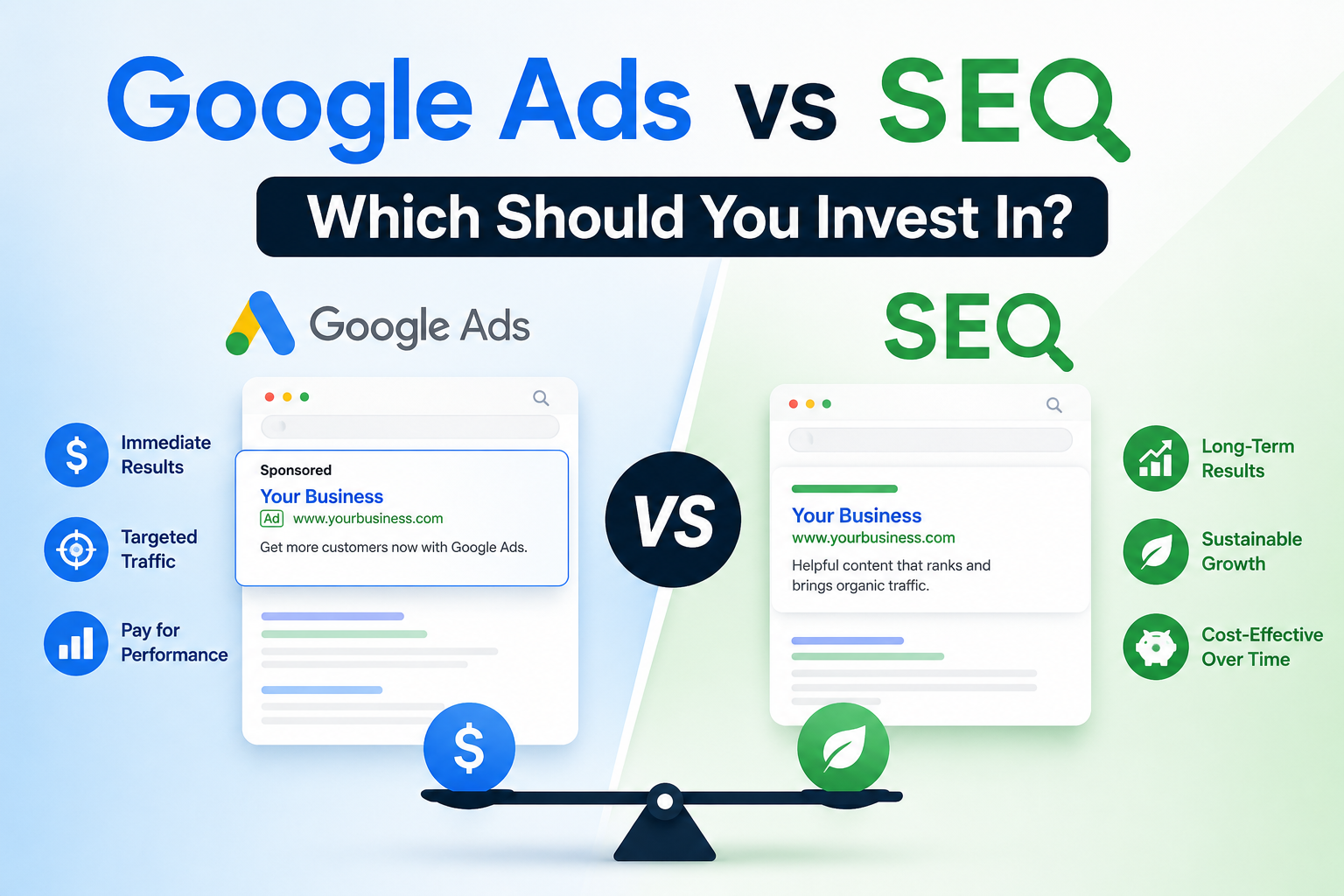
Google Ads vs SEO: Quick Comparison
| Factor | SEO | Google Ads |
|---|---|---|
| Visibility | Organic search results | Paid search results |
| Time to Results | 3–6 months or more | Hours or days |
| Cost Model | Investment in optimization and content | Pay per click |
| Traffic Source | Organic traffic | Paid traffic |
| Long-Term Value | Continues generating traffic over time | Stops when budget stops |
| Lead Generation | Builds gradually | Immediate |
| User Trust | Often higher | Clearly labeled as ads |
| Scalability | Grows over time | Increase budget for faster growth |
| Competition | Organic rankings | Keyword bidding |
| Best For | Long-term growth | Fast results |
Both strategies can work extremely well. The question is which one fits your current business situation.
The Benefits of SEO for Long-Term Business Growth
One reason businesses continue investing heavily in SEO is simple.
The results compound.
Every blog post, landing page, service page, and optimization effort adds value to your website. Over time, these assets work together to improve visibility and attract more visitors.
Imagine an accounting firm that consistently publishes tax guides and financial advice.
At first, traffic is modest. Nothing dramatic.
Six months later, they’re ranking for dozens of valuable searches. A year later, they’re generating leads from content they created months ago.
That’s the power of SEO.
Another advantage is credibility.
People naturally trust organic search results. When your website appears near the top without paying for placement, it sends a subtle signal that your business is established and reliable.
SEO also improves other marketing channels.
Better content supports email campaigns. Faster websites improve conversions. Improved user experience benefits both organic and paid traffic.
The downside?
Patience is required.
SEO rewards consistency rather than quick wins. Businesses expecting overnight success usually end up disappointed.
But for companies focused on sustainable growth, SEO often becomes one of the most profitable marketing investments they make.
The Benefits of Google Ads for Immediate Results
Sometimes businesses don’t have six months to wait.
They need leads now.
This is where Google Ads shines.
A properly managed campaign can start generating traffic almost immediately after launch. Your business can appear at the top of search results even if your website is brand new.
That’s incredibly powerful.
Let’s say you’re opening a new dental clinic.
Building organic rankings could take months. Running Google Ads allows you to appear for searches like “dentist near me” right away.
Potential patients see your business immediately.
Another major advantage is targeting.
Google Ads lets you control who sees your ads based on location, search intent, demographics, devices, and more.
That level of precision helps reduce wasted spending.
The platform also provides detailed performance data. You can track clicks, calls, inquiries, bookings, and revenue generated from your campaigns.
Few marketing channels offer that level of transparency.
For businesses launching products, promoting seasonal offers, or entering competitive markets, Google Ads often provides the fastest path to visibility and lead generation.
SEO vs Google Ads: Comparing Costs and Budget Requirements
One of the biggest misconceptions is that SEO is free.
It isn’t.
While you don’t pay for each click, SEO still requires investment. Content creation, technical optimization, website improvements, and ongoing strategy all involve time and resources.
Google Ads works differently.
You pay every time someone clicks your ad. In highly competitive industries, those clicks can become expensive quickly.
A lawyer, insurance company, or financial service provider may pay significantly more per click than a local retail store.
The benefit is speed.
The drawback is dependency.
When the ad budget stops, traffic often stops too.
SEO requires more patience upfront but can become increasingly cost-effective over time.
Many businesses eventually find that their cost per lead from organic traffic becomes much lower than paid advertising.
That’s why the smartest approach often isn’t choosing one over the other.
It’s finding the right balance.
Use Google Ads to drive immediate traffic while SEO builds long-term visibility in the background.
Which Strategy Generates Better ROI?
Business owners love this question.
Unfortunately, there’s no single answer.
Google Ads generally delivers faster ROI.
You launch campaigns, attract visitors, generate leads, and collect data quickly. This makes it ideal for testing offers, validating demand, and creating immediate revenue opportunities.
SEO operates on a different timeline.
The upfront investment may feel slower, but the long-term returns can be substantial. Once rankings are established, traffic continues arriving without paying for every visit.
Think of Google Ads as renting a storefront on a busy street.
As long as you pay rent, customers see you.
SEO is more like owning the property.
It takes longer to acquire, but the long-term value can be significantly greater.
The businesses that achieve the strongest overall ROI usually combine both approaches.
Paid search delivers immediate opportunities. Organic search creates sustainable growth.
Together, they support each other remarkably well.
Conclusion: Should You Invest in SEO, Google Ads, or Both?
The answer depends on where your business is today and where you want it to be tomorrow.
If you need immediate visibility, quick leads, and fast customer acquisition, Google Ads is often the best choice. It puts your business in front of potential customers right away and delivers measurable results quickly.
If your goal is long-term growth, stronger brand authority, and a sustainable source of traffic, SEO deserves serious attention. While it requires patience, the benefits often continue long after the initial investment.
Most successful businesses eventually realize that SEO and Google Ads aren’t competitors.
They’re partners.
Google Ads helps generate leads while SEO builds lasting visibility. One provides speed. The other provides stability.
When combined strategically, they create a marketing system that supports both short-term revenue and long-term business growth.
Instead of asking whether SEO is better than Google Ads, a better question might be this:
How can your business use both to create the strongest possible online presence?
For many companies, that’s where the real growth begins.

Leave a Reply