
Introduction
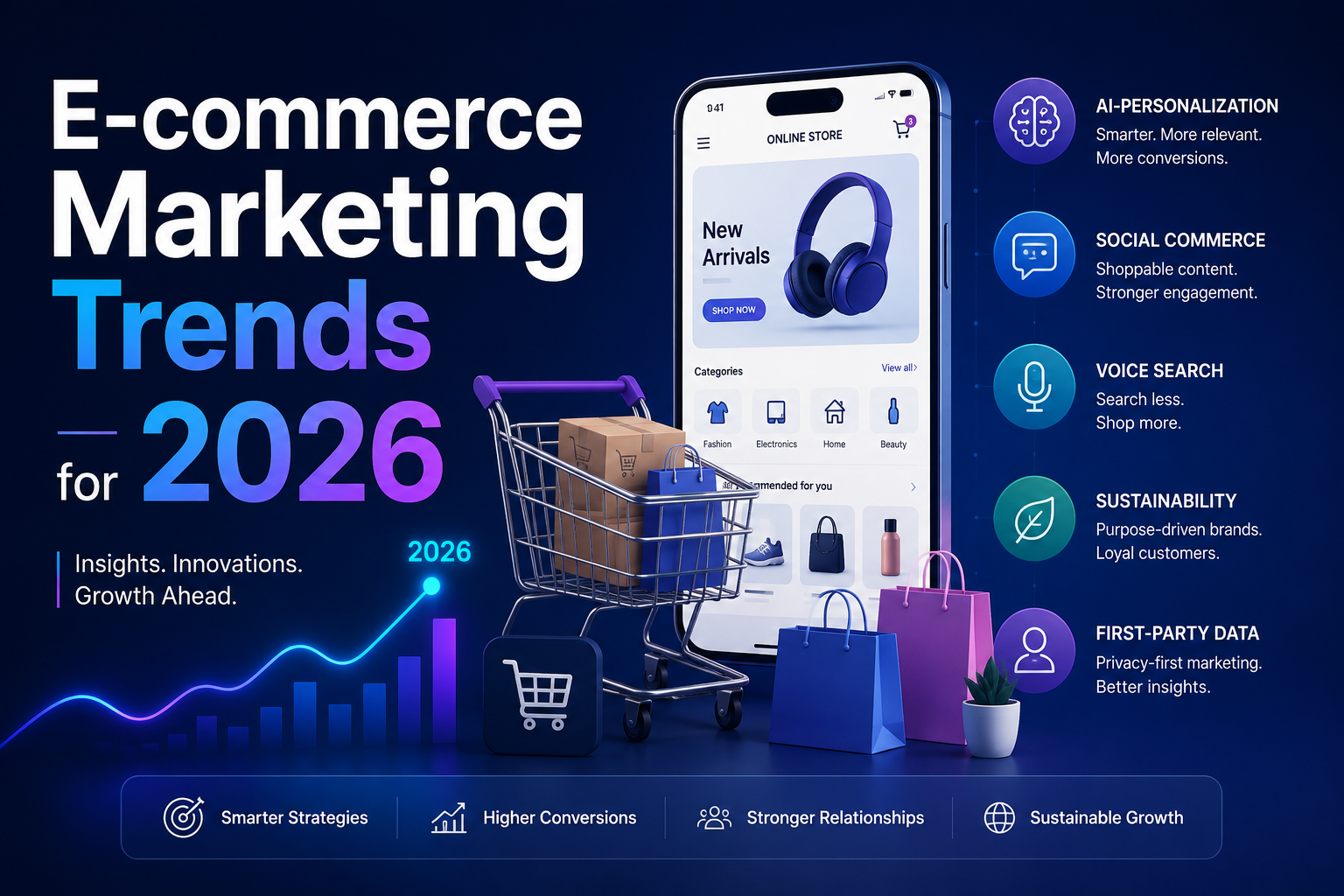
E-commerce has never stood still, but the pace of change heading into 2026 feels different. Customer expectations are rising, technology is moving faster, and competition is showing up from every direction. What helped online stores grow a few years ago may not deliver the same results today.
Consumers now expect shopping experiences that feel personal, convenient, and almost effortless. They want brands to understand what they’re looking for before they have to ask. They expect fast support, relevant recommendations, and a smooth path from discovery to purchase.
I’ve seen many businesses focus heavily on driving more traffic while overlooking the experience after a visitor arrives. That’s often where opportunities are missed. The brands winning in 2026 aren’t necessarily spending the most money. They’re creating better customer experiences.
Let’s look at the trends shaping e-commerce marketing and, more importantly, what they actually mean for businesses trying to grow online.
1. AI-Powered Personalization Becomes the Standard
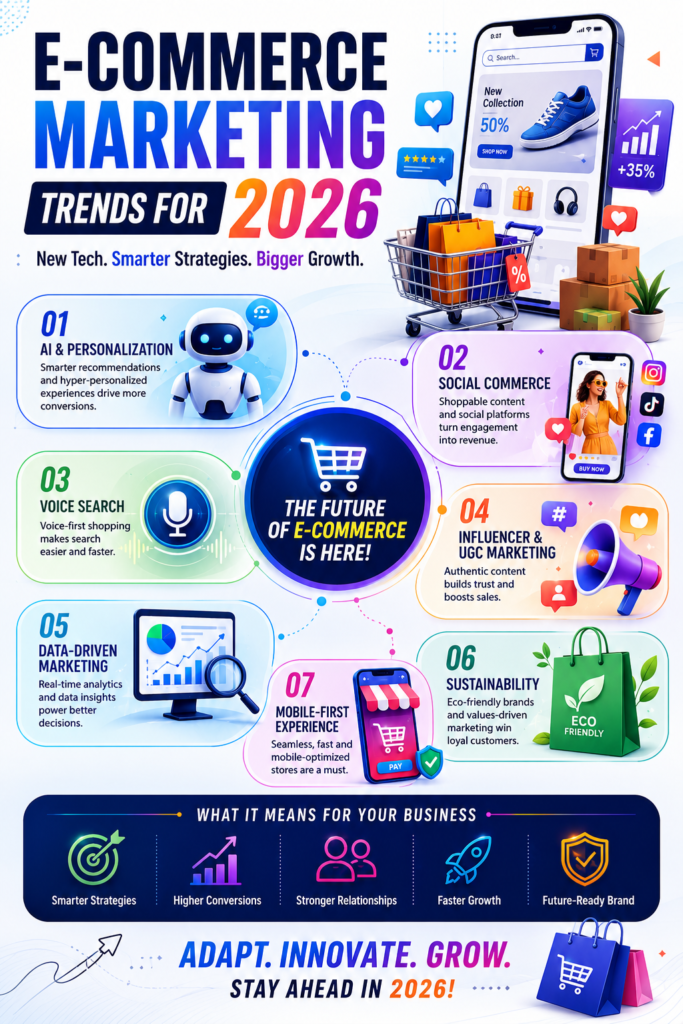
A few years ago, personalized marketing felt like a bonus. In 2026, it’s becoming an expectation.
Customers are exposed to thousands of marketing messages every day. Generic promotions simply don’t stand out anymore. People want product recommendations that match their interests, emails that feel relevant, and shopping experiences that save them time.
Artificial intelligence helps make this possible. Modern e-commerce platforms can analyze browsing behavior, purchase history, and engagement patterns to deliver more personalized experiences automatically. A customer interested in fitness equipment shouldn’t see the same homepage as someone shopping for home décor.
The practical benefit is simple. Better personalization often leads to better conversions.
One online retailer I worked with increased email revenue simply by segmenting customers based on past purchases and browsing activity. The emails weren’t complicated. They were just more relevant.
The lesson here isn’t to use AI because it’s trendy. Use it to understand customers better and remove friction from the buying process.
2. Social Commerce Continues to Dominate Online Shopping
Social media is no longer just a place where people discover products. It’s increasingly where they buy them too.
Platforms like Instagram and TikTok have shortened the customer journey dramatically. Someone can see a product, watch a demonstration, read comments, and make a purchase within minutes.
This shift is especially important for younger consumers who often trust creators and influencers more than traditional advertising. A genuine product review can outperform a polished ad campaign.
Many businesses still treat social media as a separate marketing channel. That’s becoming a mistake. Social platforms are evolving into full-scale sales channels.
If you’re selling online, make sure your products are easy to discover and purchase directly through social platforms. The fewer clicks required, the better.
Customers don’t want complicated buying journeys anymore. They want convenience.
3. Short-Form Video Becomes the Most Effective Sales Tool
Scroll through almost any social platform today and you’ll notice one thing immediately. Video dominates attention.
Short-form video works because it communicates information quickly. Instead of reading a lengthy product description, customers can watch a 20-second demonstration and immediately understand the value.
For e-commerce brands, this creates a huge opportunity.
Product tutorials, customer testimonials, behind-the-scenes footage, and quick demonstrations often outperform static images. People want to see products in action before they buy.
The good news? Production quality matters less than authenticity.
Some of the highest-performing product videos are filmed with smartphones. They’re simple, relatable, and feel real. Customers connect with that.
If you’re wondering what type of content to create, start by answering common customer questions through video. You’ll be surprised how much engagement those videos can generate.
4. Voice Search Optimization Gains Importance
Voice search has been growing steadily for years, and it’s becoming more relevant for e-commerce businesses.
The way people speak is different from the way they type. Someone may type “best running shoes,” but ask a voice assistant, “What are the best running shoes for beginners?”
That difference matters.
Businesses that optimize their content for conversational search queries often gain an advantage in voice search results. Product pages, FAQ sections, and blog content should reflect the natural language customers actually use.
Think about the questions your customers ask during sales calls or live chats. Those questions often provide excellent ideas for voice-search-friendly content.
It isn’t the most exciting trend on this list. But ignoring it could mean missing valuable traffic opportunities.
5. First-Party Data Becomes Marketing Gold
Privacy changes have forced marketers to rethink how they collect and use customer data.
Third-party tracking is becoming less reliable, which means businesses need stronger relationships with their own audiences. That’s where first-party data comes in.
Email subscribers, loyalty program members, website visitors, and existing customers all provide valuable insights. More importantly, they’re sharing information directly with your business.
The smartest brands are investing heavily in email marketing, customer surveys, preference centers, and loyalty programs. These strategies help build a database that isn’t dependent on outside platforms.
Here’s the reality: if a social platform changes its algorithm tomorrow, your email list still belongs to you.
That’s why first-party data is becoming one of the most valuable assets an e-commerce business can own.
6. Conversational Commerce Expands Rapidly
Customers have become accustomed to instant communication.
When someone has a question about a product, they don’t always want to send an email and wait a day for a response. They want answers now.
This is driving the growth of conversational commerce through live chat, messaging apps, and AI-powered customer support tools.
Modern chatbots can answer basic questions, recommend products, provide order updates, and even assist with purchases. While human support is still important, automation helps businesses serve customers around the clock.
A common concern is whether customers dislike chatbots. The truth is they dislike bad chatbots.
When implemented properly, conversational tools improve the shopping experience by reducing delays and helping customers find information faster.
Speed matters. Especially when customers are ready to buy.
7. User-Generated Content Drives Higher Trust
Trust remains one of the biggest factors influencing online purchases.
Customers naturally trust other customers more than brands. That’s why reviews, testimonials, customer photos, and user-generated videos continue to play such a powerful role in e-commerce marketing.
Think about your own shopping habits. Before making a purchase, there’s a good chance you’ve checked reviews or looked at customer photos.
Most people do.
Businesses that actively encourage customers to share experiences often create stronger credibility and social proof. This doesn’t require complicated campaigns. Sometimes a simple post-purchase email asking for feedback can generate valuable content.
User-generated content also helps potential buyers see products in real-world situations rather than carefully controlled marketing environments.
That authenticity is difficult to replicate through traditional advertising.
8. Sustainability Marketing Influences Buying Decisions
Sustainability has moved far beyond being a niche concern. For many shoppers, it’s now part of the buying decision.
That doesn’t mean customers expect every brand to become perfectly eco-friendly overnight. What they do expect is transparency. They want to know where products come from, how they’re packaged, and whether a company is making genuine efforts to reduce its environmental impact.
I’ve noticed that businesses often underestimate how much customers value honesty in this area. If you’re working toward more sustainable practices, talk about it. Share the progress. Explain the challenges. People appreciate brands that are realistic rather than those making exaggerated claims.
Simple changes can make a difference. Recyclable packaging, reduced waste, ethical sourcing, and carbon-conscious shipping options can all strengthen customer trust.
The key is authenticity. Customers can usually tell the difference between a genuine sustainability effort and a marketing campaign designed to look good.
9. Augmented Reality Enhances Online Shopping Experiences
One of the biggest disadvantages of online shopping is that customers can’t physically interact with products before purchasing.
Augmented reality helps bridge that gap.
Whether it’s visualizing a sofa in a living room, trying on glasses virtually, or seeing how a paint color looks on a wall, AR technology gives shoppers more confidence in their decisions.
Confidence matters because uncertainty often leads to abandoned carts.
Furniture, fashion, beauty, and home improvement brands are already seeing benefits from AR-powered shopping experiences. Customers gain a clearer understanding of what they’re buying, and businesses often see fewer product returns as a result.
Not every online store needs advanced AR features right away. But for businesses selling products where size, appearance, or fit are major concerns, this technology is becoming increasingly valuable.
Sometimes helping customers visualize a product is all it takes to close the sale.
10. Omnichannel Marketing Creates Seamless Customer Journeys
Today’s customer journey rarely follows a straight line.
A potential buyer might discover your brand through a social media post, visit your website later, sign up for emails, read reviews, and finally make a purchase weeks afterward. Every touchpoint plays a role.
This is why omnichannel marketing continues to grow in importance.
Customers don’t think in channels. They simply interact with brands wherever it’s most convenient. When messaging, branding, and customer experience remain consistent across platforms, trust builds naturally.
I’ve seen businesses lose sales because their website messaging didn’t match their social media content or email campaigns. It creates confusion.
Consistency doesn’t mean repeating the same message everywhere. It means creating a connected experience that feels familiar regardless of where customers engage with your brand.
The smoother the journey, the easier it becomes for customers to move toward a purchase.
11. Subscription Models Continue to Grow
Subscription-based commerce isn’t slowing down.
Consumers increasingly value convenience, especially when purchasing products they use regularly. Whether it’s skincare, pet supplies, coffee, supplements, or specialty foods, subscription models offer predictable delivery and reduced effort.
For businesses, the benefits are obvious. Recurring revenue creates more stability and improves customer lifetime value.
That said, successful subscriptions aren’t built on convenience alone. Customers need ongoing value.
The brands performing well in this space focus on flexibility. They make it easy to pause, modify, or cancel subscriptions without unnecessary friction. Ironically, making cancellation simple often increases trust and retention.
People stay longer when they don’t feel trapped.
As acquisition costs continue rising, subscription models will remain an attractive strategy for many e-commerce businesses.
12. Influencer Partnerships Become More Performance-Focused
Influencer marketing is maturing.
Brands are becoming less interested in vanity metrics like follower counts and more focused on actual business results. Engagement, conversions, customer acquisition costs, and return on investment are taking center stage.
This shift has created opportunities for micro-influencers and niche creators.
A creator with 20,000 highly engaged followers can often generate better results than someone with hundreds of thousands of passive followers. Their audience tends to trust their recommendations more, which directly impacts purchasing decisions.
The most effective partnerships feel natural. Audiences can quickly detect forced promotions, and those campaigns rarely perform well.
Businesses should focus on finding creators whose values align with their brand and whose audience matches their target customer profile.
Relevance often beats reach.
13. AI-Generated Content Accelerates Marketing Production
Content demands continue to increase across every marketing channel.
Businesses need blog posts, email campaigns, product descriptions, social media content, ad copy, and more. Creating everything manually can be time-consuming and expensive.
That’s why many marketers are incorporating AI into their content workflows.
AI tools can help generate ideas, draft outlines, write product descriptions, and speed up routine content tasks. Used properly, they can significantly improve efficiency.
However, speed isn’t everything.
Customers still respond best to content that feels human, relatable, and authentic. The brands getting the best results are using AI as a support tool rather than a complete replacement for creativity and strategic thinking.
Technology can help create content faster. Human experience is what makes that content memorable.
Finding the balance between the two will be important throughout 2026.
14. Customer Retention Becomes More Valuable Than Acquisition
For years, many businesses focused heavily on acquiring new customers. While growth remains important, rising advertising costs are changing the equation.
Keeping an existing customer is often far less expensive than acquiring a new one.
That’s why retention strategies are becoming a bigger priority. Loyalty programs, personalized email campaigns, VIP offers, exceptional customer support, and post-purchase engagement all contribute to stronger customer relationships.
One of the simplest questions businesses should ask is this: What happens after the sale?
Too often, customers complete a purchase and hear nothing from the brand until another promotion appears. That’s a missed opportunity.
The brands building long-term success stay connected with customers, provide ongoing value, and create reasons for people to return.
Retention may not always feel as exciting as acquisition. But it often delivers better results over time.
Conclusion
The future of e-commerce marketing in 2026 isn’t defined by a single platform, tool, or technology. It’s being shaped by a combination of smarter personalization, stronger customer relationships, and better shopping experiences.
Artificial intelligence, social commerce, conversational marketing, voice search, and immersive technologies are changing how businesses connect with consumers. At the same time, trust, authenticity, sustainability, and customer retention remain just as important as ever.
What’s interesting is that many of these trends aren’t really about technology alone. They’re about understanding customers better. Technology simply makes that easier.
The businesses that thrive in 2026 won’t necessarily be the ones with the biggest budgets. They’ll be the ones that listen closely to customers, adapt quickly, and focus on creating experiences that feel relevant and valuable.
For business owners, the goal shouldn’t be to chase every new trend. That’s rarely practical. Instead, identify the opportunities that align with your audience and start implementing them consistently.
Small improvements compound over time.
The e-commerce landscape will continue to evolve. It always does. But businesses that stay customer-focused, embrace useful innovation, and build genuine relationships will be in a strong position to grow no matter what changes come next.


Leave a Reply