
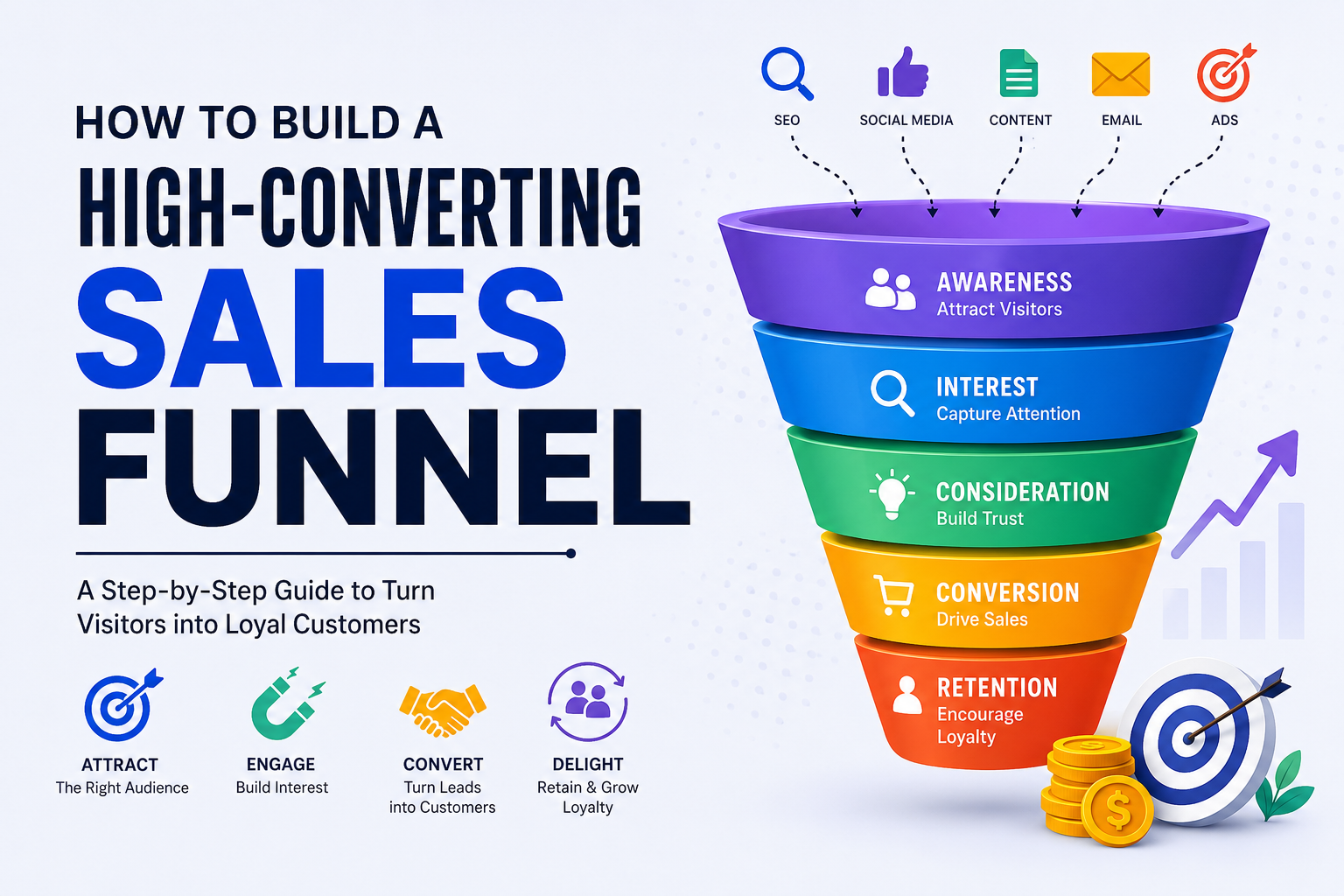
How to Build a High-Converting Sales Funnel That Actually Generates Customers
Getting traffic to your website is only half the battle. Thousands of businesses invest in SEO, paid ads, and social media every month, yet many still struggle to turn visitors into paying customers. The missing piece is often not the marketing channel—it’s the sales funnel.
A high-converting sales funnel guides potential customers from discovering your business to becoming loyal buyers. Instead of hoping visitors will contact you or make a purchase, a well-designed funnel leads them through each stage of the buying journey with the right message, offer, and call-to-action.
The biggest mistake businesses make is sending all traffic directly to their homepage. A homepage introduces your brand, but it rarely convinces someone to buy. Every visitor has different questions, objections, and levels of trust. A sales funnel addresses those concerns step by step.
Whether you’re a digital marketing agency, eCommerce brand, SaaS company, local business, or consultant, a structured sales funnel can dramatically improve your conversion rates while lowering your customer acquisition cost.
In this comprehensive guide, you’ll learn exactly how to build a high-converting sales funnel from scratch, understand each stage of the customer journey, discover common mistakes to avoid, and explore practical strategies that successful businesses use every day.
Why Every Business Needs a Sales Funnel
Imagine opening a physical store where customers walk in, glance around for a few seconds, and leave without speaking to anyone. That would be frustrating.
That’s exactly what happens on many websites.
Visitors arrive from Google or social media but don’t know:
- What makes your business different
- Why they should trust you
- What to do next
- Whether your solution is right for them
A sales funnel solves this problem by creating a clear path from curiosity to conversion.
Instead of overwhelming visitors with dozens of choices, it gives them one logical next step.
For example:
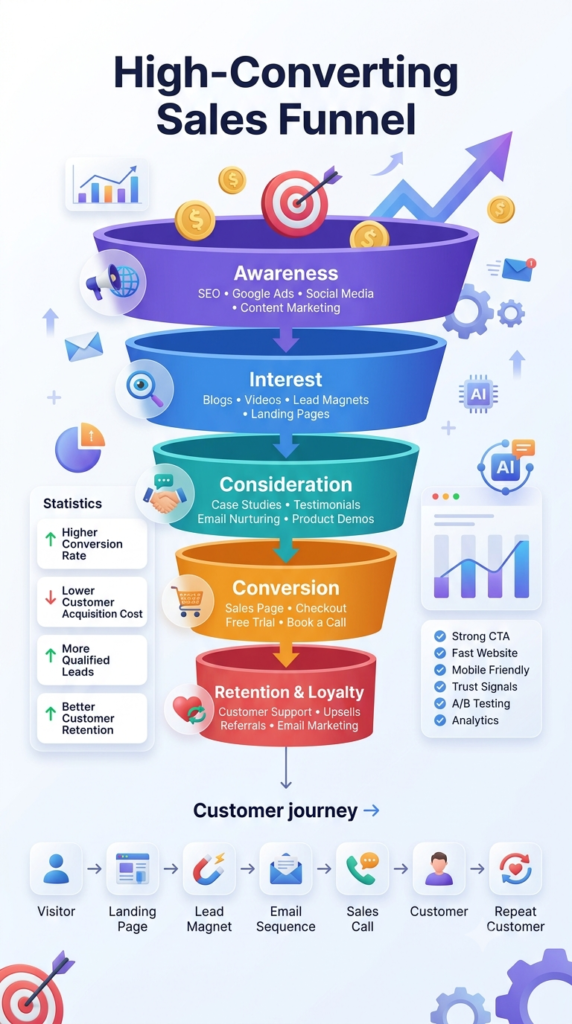
A Google search → Helpful blog article → Free guide → Email sequence → Strategy call → Paid service.
Every stage prepares users for the next decision.
Businesses with optimized funnels usually experience:
- Higher conversion rates
- Better quality leads
- Lower advertising costs
- Improved customer experience
- Higher customer lifetime value
- More predictable revenue
The best part? Once built, a funnel keeps working around the clock, turning visitors into customers even while you’re asleep.
What Is a Sales Funnel?
A sales funnel is a structured marketing process that moves potential customers from their first interaction with your brand to becoming paying customers—and ideally, repeat buyers.
It’s called a “funnel” because the number of people naturally decreases at each stage.
For example:
- 10,000 people see your content
- 2,000 visit your website
- 500 download your lead magnet
- 120 book a consultation
- 35 become customers
- 10 become long-term clients
Not everyone is ready to buy immediately.
Some people are simply researching.
Others are comparing competitors.
Many just need more trust before making a decision.
Your funnel nurtures these prospects until they’re ready.
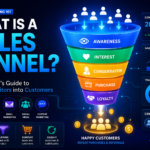
Understanding the Five Stages of a High-Converting Sales Funnel
Stage 1: Awareness
This is where people first discover your business.
They may find you through:
- Google Search
- SEO
- Blog articles
- Social media
- YouTube
- Podcasts
- Facebook Ads
- Instagram Reels
- Word of mouth
At this stage, people aren’t looking for your company specifically.
They’re searching for solutions.
For example, instead of searching:
“Best Marketing Agency”
They search:
“How to get more website leads”
That’s why educational content performs so well.
Helpful content earns attention before asking for a sale.
Stage 2: Interest
Now the visitor wants to know more.
This is where many businesses lose potential customers.
If your landing page is confusing or your website loads slowly, visitors leave.
To maintain interest, provide:
- Helpful guides
- Videos
- Case studies
- Industry statistics
- Testimonials
- Simple explanations
- Clear benefits
People don’t buy products.
They buy better outcomes.
Instead of saying:
“We provide SEO.”
Explain:
“We help local businesses generate consistent leads through long-term Google rankings.”
Notice the difference.
Stage 3: Consideration
Visitors are comparing options.
This is where trust becomes everything.
Potential customers ask themselves:
- Can I trust this company?
- Have they helped businesses like mine?
- Is the investment worth it?
- What if it doesn’t work?
Remove uncertainty by including:
Customer Success Stories
Real examples outperform generic promises.
Share measurable results.
Instead of:
“We increased traffic.”
Say:
“We increased organic traffic by 210% within eight months.”
Specific numbers create credibility.
Build Social Proof
Include:
- Google Reviews
- Video testimonials
- Client logos
- Awards
- Certifications
- Portfolio examples
- Before-and-after results
Trust reduces hesitation.
Address Common Objections
Don’t wait for prospects to ask questions.
Answer them first.
Examples include:
- Pricing concerns
- Project timelines
- Contract requirements
- Refund policies
- Support availability
- Expected results
The fewer unanswered questions, the higher your conversion rate.
Stage 4: Conversion
Now it’s time to make buying easy.
Many businesses accidentally reduce conversions by asking visitors to do too much.
Instead of giving users multiple choices, focus on one clear goal.
Examples include:
- Book a consultation
- Request a quote
- Schedule a demo
- Purchase a product
- Start a free trial
Every landing page should have one primary call-to-action.
Avoid distracting visitors with unnecessary navigation links, excessive text, or unrelated offers.
A high-converting conversion page should include:
- A compelling headline
- A concise value proposition
- Customer testimonials
- Key benefits
- A simple contact form
- A strong call-to-action button
- Trust badges or guarantees
The easier it is to take action, the more likely visitors are to convert.
Stage 5: Retention and Advocacy
Many businesses stop marketing after making a sale.
That’s a costly mistake.
Existing customers are often easier to retain than acquiring new ones.
After the purchase, continue delivering value through:
- Onboarding emails
- Helpful tutorials
- Exclusive offers
- Customer support
- Loyalty programs
- Regular follow-ups
- Educational content
Happy customers often become your best marketers by leaving reviews, referring others, and sharing their positive experiences.
A great sales funnel doesn’t end with a purchase—it creates long-term relationships.
The Psychology Behind High-Converting Sales Funnels
Successful funnels aren’t built on clever design alone. They’re built on understanding human behavior.
People make buying decisions based on a mix of emotion and logic. First, they feel a problem or desire, then they use facts to justify their choice.
A strong funnel addresses both sides.
For example:
- Emotion: “I’m frustrated that my website isn’t generating leads.”
- Logic: “This agency increased lead generation by 180% for similar businesses.”
Your content should help visitors imagine a better outcome while providing enough evidence to make them feel confident in taking the next step.
Another important principle is reducing friction. Every extra form field, confusing message, or unnecessary click creates resistance. Simplifying the customer journey often improves conversions more than redesigning the entire website.
Common Mistakes That Kill Sales Funnel Conversions
Even businesses with high website traffic can struggle if their funnel has weak points. Here are some of the most common mistakes:
- Driving traffic to a generic homepage instead of a targeted landing page.
- Using unclear or multiple calls-to-action on the same page.
- Asking for too much information in lead forms.
- Ignoring mobile users and slow-loading pages.
- Failing to build trust with testimonials, case studies, and guarantees.
- Not following up with leads through email or remarketing campaigns.
- Measuring traffic instead of actual conversions and revenue.
Fixing just one of these issues can lead to noticeable improvements in conversion rates.
Step-by-Step Guide to Building a High-Converting Sales Funnel
A successful sales funnel doesn’t happen by chance. Every page, email, and offer should have one purpose: moving the visitor one step closer to becoming a customer.
Instead of trying to sell immediately, focus on creating a journey. When each stage naturally leads to the next, conversions increase without feeling pushy.
Let’s break down the process.
Step 1: Know Your Ideal Customer Better Than Your Competitors
Many businesses start by designing landing pages or running ads. The smarter approach is to first understand who you’re speaking to.
Ask questions like:
- What problem keeps them awake at night?
- What result are they hoping to achieve?
- What are they currently doing to solve it?
- Why hasn’t that solution worked?
- What objections might stop them from buying?
For example, if you’re a digital marketing agency, “business owners” is too broad. A much clearer audience could be:
- Local service businesses with fewer than 20 employees.
- E-commerce brands struggling with abandoned carts.
- SaaS startups looking to reduce customer acquisition costs.
The more specific your audience, the more relevant your messaging becomes.
Pro Tip: Create a one-page customer persona that includes goals, frustrations, buying triggers, preferred communication channels, and common objections. This document should guide all your marketing decisions.
Step 2: Create an Irresistible Lead Magnet
Most visitors won’t buy on their first visit. That’s why you need a lead magnet—something valuable offered in exchange for their contact information.
A strong lead magnet solves one specific problem quickly.
Popular examples include:
- Free SEO audit
- Marketing strategy checklist
- Industry report
- ROI calculator
- Website performance audit
- Free consultation
- Templates
- Swipe files
- Email sequences
- Mini video course
The biggest mistake is offering something too general.
Instead of:
“Download Our Marketing Guide”
Offer:
“25 SEO Mistakes That Are Costing Businesses Thousands of Visitors Every Month.”
Specific offers usually generate higher conversion rates because visitors immediately understand the value.
Step 3: Build a Landing Page That Converts
Your landing page has one job: convince visitors to take the next step.
Every unnecessary element reduces conversions.
A high-performing landing page typically includes:
A Powerful Headline
Your headline should clearly communicate the benefit.
Example:
Grow Your Business with a Sales Funnel That Converts Visitors Into Paying Customers.
A Clear Value Proposition
Explain:
- What you offer
- Who it’s for
- Why it’s different
- What result users can expect
Avoid vague statements like:
“We provide innovative digital solutions.”
Instead write:
“We help small businesses generate more qualified leads through data-driven marketing strategies.”
Benefits Over Features
People don’t buy software, services, or products.
They buy outcomes.
Instead of listing features, explain the transformation.
Example:
Feature:
✔ CRM Integration
Benefit:
✔ Never lose track of a lead again with automated follow-ups.
Social Proof
Trust is built through evidence.
Include:
- Customer testimonials
- Star ratings
- Video reviews
- Client logos
- Case studies
- Awards
- Years of experience
- Number of successful projects
Social proof reduces uncertainty and encourages visitors to take action.
Strong Call-to-Action (CTA)
Use action-oriented language.
Examples:
- Get My Free Audit
- Download the Guide
- Book My Strategy Call
- Start My Free Trial
- Claim My Free Consultation
Avoid generic buttons like:
- Submit
- Click Here
- Learn More
Your CTA should tell visitors exactly what they’ll receive.
Step 4: Use Email Marketing to Nurture Leads
One of the biggest myths in marketing is that every visitor who doesn’t convert is lost.
In reality, many people simply need more time and information before making a decision.
This is where email marketing becomes one of the highest-ROI channels.
Instead of sending random promotional emails, create an automated sequence that educates, builds trust, and gradually moves subscribers toward a purchase.
A simple nurture sequence could look like this:
Email 1: Welcome + Deliver the promised lead magnet.
Email 2: Share a quick success story or case study.
Email 3: Teach a practical tip your audience can use immediately.
Email 4: Address a common objection.
Email 5: Introduce your service with a compelling offer.
Each email should provide genuine value rather than feeling like a sales pitch.
Step 5: Qualify Your Leads
Not every lead is ready—or even the right fit—for your business.
Lead qualification helps you focus on prospects who are most likely to become customers.
You can qualify leads based on factors like:
- Budget
- Business size
- Industry
- Urgency
- Decision-making authority
- Current challenges
This saves time and allows your sales team to prioritize high-value opportunities.
Step 6: Follow Up Consistently
Research consistently shows that many sales happen only after multiple follow-ups.
Yet many businesses stop after one email or one phone call.
A simple follow-up system might include:
- Thank-you email immediately after form submission.
- Helpful follow-up after two days.
- Case study after five days.
- Limited-time offer after one week.
- Final reminder before closing the campaign.
Consistency keeps your brand top of mind without overwhelming potential customers.
Step 7: Make Buying Simple
Every additional click or unnecessary form field creates friction.
Ask yourself:
- Is this information truly necessary?
- Can the checkout process be shortened?
- Are payment options convenient?
- Is the call-to-action obvious?
Sometimes reducing a contact form from ten fields to four can significantly increase conversions.
A smoother experience often leads to more completed purchases or inquiries.
Essential Metrics Every Sales Funnel Should Track
Without measurement, it’s impossible to know what’s working.
Focus on metrics that directly impact business growth.
| Metric | Why It Matters |
|---|---|
| Landing Page Conversion Rate | Measures how many visitors become leads. |
| Click-Through Rate (CTR) | Indicates how compelling your ads or emails are. |
| Cost Per Lead (CPL) | Helps evaluate marketing efficiency. |
| Customer Acquisition Cost (CAC) | Shows how much it costs to gain a customer. |
| Average Order Value (AOV) | Measures revenue per transaction. |
| Sales Conversion Rate | Tracks how many leads become customers. |
| Email Open Rate | Reflects subject line effectiveness. |
| Email Click Rate | Indicates engagement with email content. |
| Customer Lifetime Value (CLV) | Estimates long-term customer profitability. |
| Funnel Drop-Off Rate | Reveals where potential customers leave the journey. |
Regularly reviewing these metrics allows you to identify weak points and improve your funnel over time.
Best Tools for Building a Sales Funnel
The right tools can automate repetitive tasks and help you scale your marketing efforts.
Here are some popular options:
Landing Page Builders
- Unbounce
- Leadpages
- Instapage
- Elementor (WordPress)
Email Marketing Platforms
- Mailchimp
- Brevo
- ActiveCampaign
- ConvertKit
CRM Software
- HubSpot CRM
- Zoho CRM
- Salesforce
- Pipedrive
Analytics and Tracking
- Google Analytics 4
- Google Tag Manager
- Microsoft Clarity
- Hotjar
Automation Tools
- Zapier
- Make (formerly Integromat)
- n8n
Choose tools that fit your business size and budget. A simple, well-integrated stack often performs better than using too many disconnected platforms.
Real-World Example of a High-Converting Sales Funnel
Imagine a digital marketing agency that specializes in helping local businesses.
Here’s how its funnel might work:
- A business owner searches Google for “How to get more local leads.”
- They find a helpful blog post optimized for SEO.
- The article offers a free “Local SEO Checklist” in exchange for an email address.
- After downloading the checklist, the visitor receives a five-email educational series.
- One email features a case study showing how a local business increased inquiries by 180%.
- The final email invites the reader to book a free strategy session.
- During the consultation, the agency presents a customized growth plan.
- The prospect becomes a client and later receives ongoing support, monthly reports, and opportunities to upgrade services.
Each step adds value, builds trust, and naturally leads to the next action instead of pushing for an immediate sale.
Advanced Conversion Optimization Tips
Once your funnel is generating consistent results, small improvements can have a big impact.
Some effective optimization strategies include:
- Test different headlines using A/B testing.
- Experiment with CTA button text and placement.
- Use heatmaps to understand visitor behavior.
- Add video testimonials to increase trust.
- Simplify forms and reduce unnecessary fields.
- Improve page speed, especially on mobile devices.
- Personalize content based on user behavior or traffic source.
- Retarget visitors who leave without converting using email or paid ads.
Even a small increase in conversion rate can significantly improve overall revenue when applied across your entire funnel.
Common Sales Funnel Mistakes That Reduce Conversions
Even businesses with excellent products and strong marketing campaigns can struggle if their sales funnel has weak points. In many cases, improving conversions isn’t about spending more on ads—it’s about fixing the journey users take before they decide to buy.
Here are some of the most common mistakes that prevent funnels from performing at their best.
1. Trying to Sell Too Early
One of the biggest mistakes is asking visitors to buy before they’ve built enough trust. Most people don’t make purchasing decisions immediately, especially for high-value products or services.
Instead of pushing for a sale on the first interaction, focus on educating your audience, answering their questions, and demonstrating your expertise. Valuable content, case studies, and free resources help move prospects closer to a buying decision naturally.
2. Ignoring Mobile Users
More than half of website traffic now comes from smartphones. If your landing pages are slow, difficult to navigate, or poorly formatted on mobile devices, you’re likely losing potential customers before they even read your offer.
A mobile-friendly funnel should include:
- Fast-loading pages
- Responsive design
- Easy-to-read text
- Large CTA buttons
- Simple forms with minimal fields
A smooth mobile experience often leads to higher engagement and better conversion rates.
3. Weak or Confusing Calls-to-Action
If visitors don’t know what to do next, they usually do nothing.
Every page should have one primary objective and one clear CTA. Avoid offering multiple competing actions that distract users from the goal.
Good examples include:
- Book Your Free Consultation
- Download the Free Guide
- Get Your Custom Quote
- Start Your Free Trial
Clear, action-focused language performs much better than generic buttons like “Submit” or “Click Here.”
4. Not Building Enough Trust
People rarely buy from businesses they don’t trust.
Trust signals help reduce uncertainty and reassure potential customers. Include elements such as:
- Customer testimonials
- Video reviews
- Google ratings
- Case studies
- Client logos
- Industry certifications
- Money-back guarantees (when appropriate)
The more credible your business appears, the easier it becomes for visitors to take the next step.
5. Failing to Test and Optimize
Many businesses launch a funnel and never revisit it. However, even small improvements can produce significant gains.
Regularly test:
- Headlines
- Images
- CTA button text
- Form length
- Page layout
- Pricing presentation
- Email subject lines
Continuous optimization is one of the most effective ways to improve long-term performance.
AI Is Changing Sales Funnels in 2026
Artificial Intelligence has transformed how businesses attract, qualify, and convert leads. Instead of relying solely on manual processes, modern sales funnels use AI to deliver more personalized experiences at scale.
Here are a few practical applications:
AI Chatbots
AI-powered chatbots can answer common questions instantly, recommend products, qualify leads, and schedule appointments—24/7.
Predictive Lead Scoring
AI analyzes user behavior to identify which leads are most likely to convert. This helps sales teams prioritize their efforts and improve efficiency.
Personalized Content
AI tools can recommend relevant products, articles, or offers based on a visitor’s browsing history, increasing engagement and conversion rates.
Automated Email Campaigns
Modern email platforms use AI to determine the best time to send emails, personalize subject lines, and tailor content to individual users.
Smart Analytics
AI can identify bottlenecks in your funnel, predict user behavior, and suggest optimization opportunities based on real data.
Unique Insight: AI should enhance your sales funnel—not replace the human touch. Automated systems can handle repetitive tasks, but trust, relationships, and meaningful conversations remain essential for long-term success.
A High-Converting Sales Funnel Checklist
Before launching your funnel, use this checklist to ensure you’ve covered the essentials.
Awareness
- Target audience clearly defined
- SEO-optimized content created
- Paid advertising strategy in place
- Social media content driving traffic
Lead Generation
- Valuable lead magnet created
- Optimized landing page
- Strong CTA
- Mobile-friendly design
Lead Nurturing
- Automated email sequence
- Educational content
- Customer success stories
- Objection-handling emails
Conversion
- Simple contact or checkout process
- Clear pricing (if appropriate)
- Trust signals throughout the funnel
- Fast-loading pages
Retention
- Welcome email
- Customer onboarding
- Feedback requests
- Upsell and cross-sell opportunities
- Referral program
Unique Strategies Used by High-Performing Businesses
Many businesses focus only on getting more traffic, but the most successful companies focus on increasing the value of every visitor.
Here are a few strategies that often separate high-performing funnels from average ones:
Offer Micro-Commitments
Instead of asking visitors to book a call immediately, encourage a smaller action first—such as taking a quiz, downloading a checklist, or watching a short video. Small commitments make larger decisions feel easier later.
Use Interactive Content
Quizzes, calculators, assessments, and interactive tools keep visitors engaged while collecting valuable information about their needs. This data can be used to personalize follow-up messages.
Match Content to Buyer Intent
Someone searching “What is a sales funnel?” needs educational content. Someone searching “Best sales funnel software” is much closer to making a purchase. Tailoring your content to the user’s intent improves both engagement and conversions.
Measure Revenue, Not Just Leads
Generating hundreds of leads means little if they don’t become paying customers. Evaluate your funnel based on revenue, customer lifetime value, and profitability—not just lead volume.
Final Thoughts
A high-converting sales funnel isn’t built overnight. It requires a deep understanding of your audience, valuable content, consistent follow-up, and ongoing optimization.
The businesses that see the best results are those that treat their sales funnel as a living system. They monitor performance, test new ideas, listen to customer feedback, and make continuous improvements.
Remember, a successful funnel doesn’t pressure people into buying—it guides them toward the right decision by providing the right information at the right time.
As AI, automation, and personalization continue to evolve, businesses that combine technology with genuine customer value will be best positioned for long-term growth.
If you invest time in building a thoughtful, user-focused sales funnel today, you’ll create a marketing asset that continues to generate leads, sales, and loyal customers for years to come.
Frequently Asked Questions (FAQs)
1. What is a high-converting sales funnel?
A high-converting sales funnel is a structured process that guides potential customers from discovering your business to becoming paying customers. It uses targeted content, landing pages, email nurturing, and optimized calls-to-action to maximize conversions.
2. Why is a sales funnel important for businesses?
A sales funnel helps businesses turn website visitors into qualified leads and customers. It improves conversion rates, builds trust, shortens the buying journey, and creates a more predictable sales process.
3. What are the main stages of a sales funnel?
The five main stages are:
- Awareness
- Interest
- Consideration
- Conversion
- Retention and Advocacy
Each stage addresses different customer needs and encourages the next action.
4. How long does it take to build an effective sales funnel?
A basic funnel can be built in a few days, but optimizing it for maximum performance typically takes several weeks or months. Continuous testing and improvements are essential for long-term success.
5. Which tools are best for creating a sales funnel?
Popular tools include:
- HubSpot
- ClickFunnels
- Unbounce
- Leadpages
- Mailchimp
- ActiveCampaign
- Google Analytics 4
- Hotjar
- Zapier
The right choice depends on your business goals and budget.
6. How can I increase my sales funnel conversion rate?
Improve your conversion rate by:
- Writing stronger headlines
- Using clear CTAs
- Simplifying forms
- Adding testimonials
- Improving page speed
- Personalizing content
- Following up with email automation
- Regularly A/B testing your funnel
7. What’s the difference between a landing page and a sales funnel?
A landing page is a single page designed for one specific action, while a sales funnel is the complete journey that moves a visitor from awareness to conversion and beyond. A landing page is one part of the overall funnel.
8. Can small businesses benefit from a sales funnel?
Absolutely. Sales funnels help small businesses compete with larger brands by improving lead generation, increasing conversion rates, and making marketing efforts more efficient without necessarily increasing advertising spend.
9. How does AI improve a sales funnel?
AI can automate lead qualification, personalize customer experiences, optimize email campaigns, provide chatbot support, analyze user behavior, and identify opportunities to improve conversions through data-driven insights.
10. What is the most important element of a successful sales funnel?
Understanding your audience is the foundation of every successful sales funnel. When you know your customers’ goals, pain points, and objections, you can create content and offers that naturally guide them toward becoming loyal customers.
Leave a Reply