
Introduction
Digital marketing in 2026 doesn’t look anything like it did a few years ago. Back then, marketers spent hours analyzing reports, researching keywords, creating content, and optimizing campaigns manually. It worked. But it was slow.
Then AI arrived.
At first, many businesses treated Artificial Intelligence as another industry buzzword. Something exciting. Something futuristic. But not something they needed immediately. That thinking changed quickly.
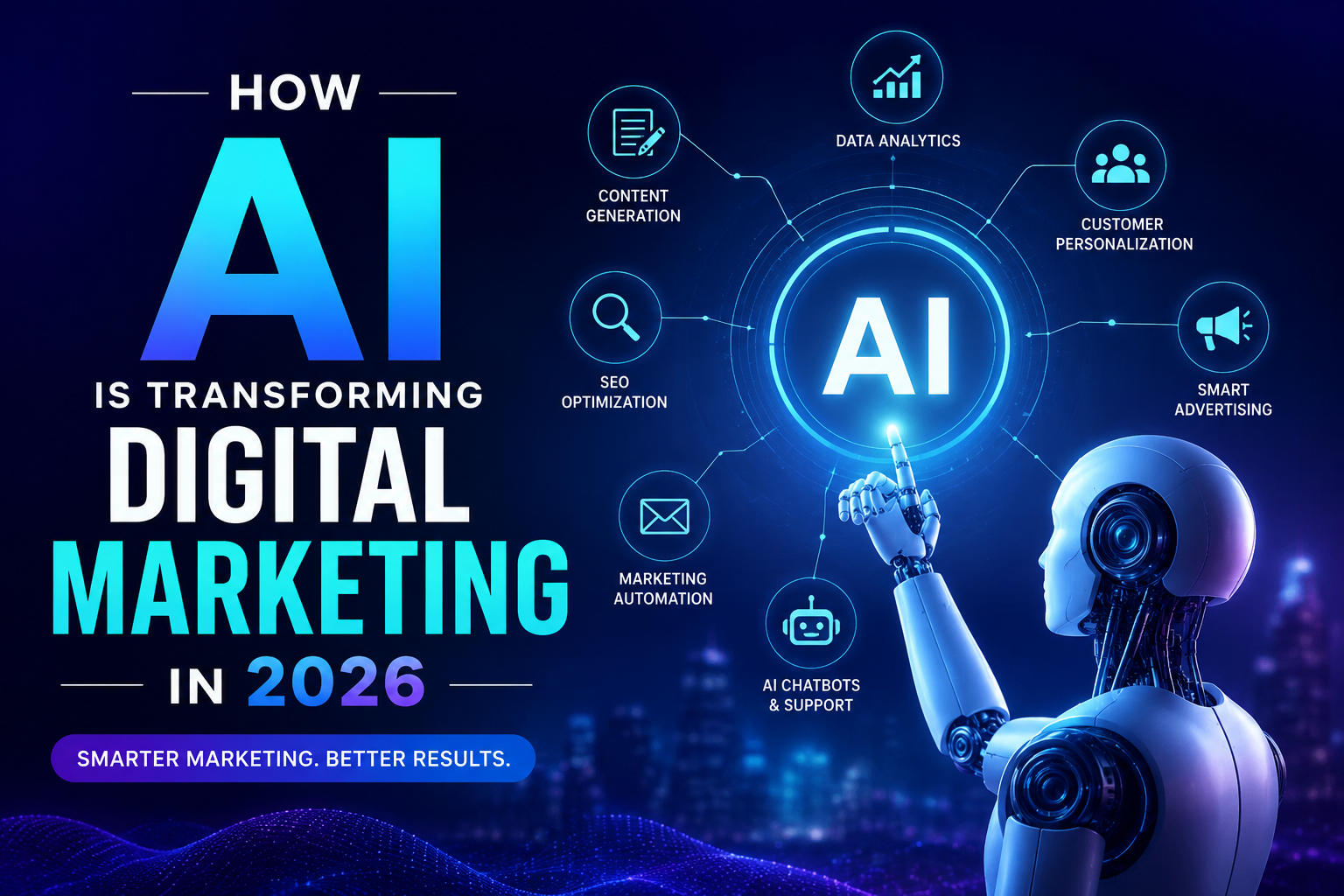
Today, AI sits at the center of modern marketing strategies. It’s helping brands create content in minutes, predict customer behavior before it happens, personalize experiences at scale, and automate tasks that once consumed entire workdays. The shift has been massive. And it’s still accelerating.
Imagine visiting an online store and instantly seeing products that match your interests. You open an email and the offer feels tailored specifically for you. You search for information online and find exactly what you need within seconds. Behind many of these experiences, AI is working quietly in the background.
For businesses, this means more opportunities to connect with customers. For marketers, it means making smarter decisions with less guesswork. And for consumers, it means more relevant and personalized experiences than ever before.
In this guide, we’ll explore how AI is transforming digital marketing in 2026 and why businesses that embrace it are gaining a serious competitive advantage.
Understanding AI in Digital Marketing
Artificial Intelligence refers to technologies that can analyze data, recognize patterns, learn from interactions, and make decisions with minimal human intervention.
Sounds complex. But in marketing, the goal is actually pretty simple.
AI helps businesses understand customers better.
Every day, people generate huge amounts of data through website visits, social media interactions, purchases, searches, and online engagement. Manually analyzing all this information would take forever. AI can process it in seconds.
As a result, businesses can deliver better experiences, improve campaign performance, and make more informed marketing decisions.
Why AI Has Become Essential in 2026
Customer expectations have changed dramatically.
People don’t just want products anymore. They want personalized experiences. They expect brands to know their preferences, understand their needs, and provide relevant recommendations.
That’s a challenge.
A company with thousands of customers can’t manually personalize every interaction. AI makes it possible.
By analyzing customer behavior in real time, AI helps businesses deliver personalized content, targeted advertisements, and customized recommendations at scale.
The result? Better engagement, higher conversion rates, and stronger customer loyalty.
AI-Powered Content Creation
Content remains one of the most important parts of digital marketing. Blogs, emails, social media posts, landing pages, and videos all play a role in attracting and converting customers.
The problem is that creating quality content consistently takes time.
Lots of time.
AI-powered content tools are helping marketers speed up the process.
Today, businesses use AI to generate blog outlines, write first drafts, create product descriptions, develop email campaigns, and even brainstorm creative ideas.
That doesn’t mean human writers are becoming obsolete. Not even close.
The best content still requires human creativity, expertise, and storytelling. AI simply removes many of the repetitive tasks, allowing marketers to focus on strategy and quality.
AI and Search Engine Optimization (SEO)
SEO has become more sophisticated than ever.
Search engines now understand context, intent, and user behavior at a much deeper level. Ranking well requires more than simply adding keywords to a page.
AI is helping marketers adapt.
Modern SEO tools use AI to identify keyword opportunities, analyze competitors, discover content gaps, and predict future search trends.
One of the biggest advantages is predictive SEO.
Instead of reacting to trends after they become popular, businesses can identify emerging topics early and create content before competitors flood the market.
That’s a huge advantage.
Hyper-Personalization at Scale
Personalization isn’t new. But AI has taken it to an entirely different level.
Think about streaming platforms recommending shows you’ll probably enjoy. Or e-commerce websites suggesting products based on your browsing history.
That’s AI-driven personalization.
In digital marketing, AI analyzes customer behavior, purchase patterns, interests, and engagement history to create highly customized experiences.
This can include:
- Personalized website content
- Product recommendations
- Tailored email campaigns
- Dynamic offers
- Customized advertisements
Customers feel understood. Businesses see higher conversions.
Everyone wins.
AI-Powered Advertising
Advertising platforms have become smarter thanks to machine learning.
Years ago, marketers manually adjusted bids, monitored audiences, and optimized campaigns. It was a constant process.
Now AI handles much of the heavy lifting.
Advertising systems can automatically analyze performance data, adjust budgets, identify high-converting audiences, and optimize ad delivery in real time.
This means businesses spend less money on ineffective ads and more money reaching the right people.
The efficiency gains are significant.
Marketing Automation Gets Smarter
Automation isn’t a new concept. But AI has made it dramatically more intelligent.
Modern marketing automation platforms don’t just send scheduled emails. They respond to customer behavior.
For example, if someone downloads a guide from your website, AI can automatically trigger a personalized email sequence based on their interests.
If a customer abandons their shopping cart, AI can send a targeted reminder at the optimal time.
These automated interactions feel more natural because they’re driven by real customer data rather than generic workflows.
AI Chatbots and Conversational Marketing
Customer expectations have changed.
People want answers immediately.
Waiting hours for a response is no longer acceptable for many consumers.
This is where AI-powered chatbots have become incredibly valuable.
Modern chatbots can answer questions, recommend products, schedule appointments, qualify leads, and provide support 24 hours a day.
They’re faster. More accurate. And increasingly human-like.
While complex issues still require human support, chatbots now handle a large percentage of routine customer interactions.
Predictive Analytics: Looking Into the Future
One of AI’s most powerful capabilities is prediction.
By analyzing historical data and behavioral patterns, AI can forecast future outcomes with impressive accuracy.
Businesses use predictive analytics to:
- Forecast sales
- Predict customer churn
- Estimate campaign performance
- Identify high-value prospects
- Improve inventory planning
Instead of making decisions based on assumptions, marketers can rely on data-driven predictions.
That changes everything.
AI in Social Media Marketing
Social media moves fast.
Trends appear overnight and disappear just as quickly.
Keeping up manually can be difficult.
AI helps marketers identify trending topics, analyze audience sentiment, determine optimal posting times, and monitor brand mentions across multiple platforms.
This allows businesses to stay relevant and engage audiences more effectively.
In a crowded digital landscape, that matters.
A lot.
Challenges of AI in Marketing
Despite its benefits, AI isn’t perfect.
Businesses still face challenges related to data privacy, ethical concerns, implementation costs, and skill gaps.
There’s also the risk of over-automation.
Customers still value genuine human connection. Brands that rely too heavily on automation can sometimes feel robotic or impersonal.
The most successful companies understand this balance.
They use AI to enhance human creativity rather than replace it.
The Future of Digital Marketing
The future of marketing will be increasingly shaped by AI.
We’ll see more advanced personalization, smarter search experiences, better predictive analytics, and increasingly autonomous marketing systems.
But one thing is unlikely to change.
Human creativity.
Technology can analyze data and automate tasks. It can generate ideas and identify patterns. But authentic storytelling, emotional intelligence, and strategic thinking remain uniquely human strengths.
The businesses that combine AI efficiency with human creativity will continue to lead the market.
Conclusion
Artificial Intelligence has become one of the most powerful forces shaping digital marketing in 2026. From content creation and SEO to advertising, automation, personalization, and predictive analytics, AI is helping businesses operate more efficiently and connect with customers in more meaningful ways.
The brands achieving the greatest success aren’t replacing people with AI. They’re combining the strengths of both.
As technology continues to evolve, marketers who embrace AI while maintaining a human-centered approach will be best positioned for long-term growth.
The future of digital marketing isn’t human versus AI.
It’s human creativity powered by AI.


Leave a Reply